Mahagonnyn kaupungin nousu ja tuho (The Rise and Fall of the City of Mahagonny), opera by Kurt Weill (music) and Bertolt Brecht (libretto), translated by Pentti Saaritsa, directed by Mikko Kouki. Turku City Theatre with Saaristo-Ooppera and the Turku Philharmonic Orchestra. April–May 2026.
The Rise and Fall of the City of Mahagonny is a two-act opera composed by Kurt Weill (1900–1950), based on a libretto by Bertolt Brecht (1898–1956). Loaded with satire and jazz flavors, the play offers a bitingly overstated commentary on capitalist economy and its cultural manifestations through an imaginary city with both utopian and dystopian qualities.
The opera originally premiered in Leipzig in March 1930, amid the ideological turmoil of the late Weimar Republic. Now set in the rather more tranquil and unequivocally bourgeois riverside of spring-time Turku, the opera finds new resonances. Yet it has lost little of its topicality, offering a perfect excuse for a political theorist’s recreational traveling and occasional reflections on the politics of art.
Mahagonny does not so much narrate as it shows social phenomena and invites the audience to observe, reflect, and judge for themselves.
Mahagonny encompasses 20 scenes, each provoking reflections on varying aspects of the eponymous utopia-turned-dystopia. It shows the decay of a city artificially founded for commercialized overindulgence. The episodes discuss prostitution, gambling, alcoholism, overeating, violence, and corruption, among other capitalist vices. While the Threepenny Opera (1928) brought criminals into on-stage interaction with businessmen, bankers, and law-enforcers and in a carnivalesque manner suggested the identity of crime, business, and law in capitalism, Mahagonny zooms in on the system’s eventual cultural outcomes.
It is an image of destruction; simultaneously both apocalyptic-dystopic in its content and unfoundedly wishful its proposition that the inhuman contradictions inherent in advanced capitalism would culminate into a systemic reconfiguration. The posteriority knows that the unstable Weimar order in fact changed soon, which casts further ironical light on the apocalypse.
Firmly set in the tradition of Brechtian epic theatre, Mahagonny does not so much narrate as it shows social phenomena and invites the audience to observe, reflect, and judge for themselves. The spectator is presumed to be actively aware that they are witnessing a performance in everyday reality, not to get drawn into compensatory phantasms.
Correspondingly, the storyline is intentionally sketchy. Instead of sustained narrative illusions, subtle individual-level psychological development, or societal coming-of-age, typical of bourgeois art, the plot tumbles like a quadrangular wheel. Main characters die one by one as results of their excesses, and the absurdity accumulates. The scenes are distinct, yet connected, like single shots in a film strip, as Brecht’s friend and colleague, the essayist Walter Benjamin once noted (Benjamin, Understanding Brecht, 38). The montage-like set of episodes somewhat heavy-handedly guides the spectator to deduce the inevitable conclusion: this is not a society for human beings – yet not very far from ours.
The utopia/dystopia that is Mahagonny
The play employs means of expression from the tradition of utopian and dystopian art. Mahagonny is a no-place (u-topos), set somewhere in the West and carrying the stereotypical characteristics nowadays associated with Las Vegas. Brecht’s satirical Americanism runs rampant. Whisky, Cocktail, Alaska, and Knock-Out – with German capitalizations – serve as its magic words. The protagonists’ full names vary by edition, sometimes being stereotypically German (Jacob Schmidt, Paul Ackermann) and sometimes sounding like juvenile parody of Anglo-Saxon naming practices (Jim Mahoney, Jack O’Brien, Fatty, Bank-Account Billy, Alaskawolfjoe).
Such globality and cultural colonialism highlights the lack of unequivocal spatial ties; while Mahagonny is modeled after US cities, it could be anywhere, since it primarily exemplifies a specific societal logic. The satire, however, equally hits self-purposeful Weimar-era internationalism – including that of Weill, the connoisseur of American stage music who would himself soon emigrate and embark on a more commercially oriented career on Broadway.
Whoever has money, can attempt emancipation; yet precisely property and enjoyment enslave.
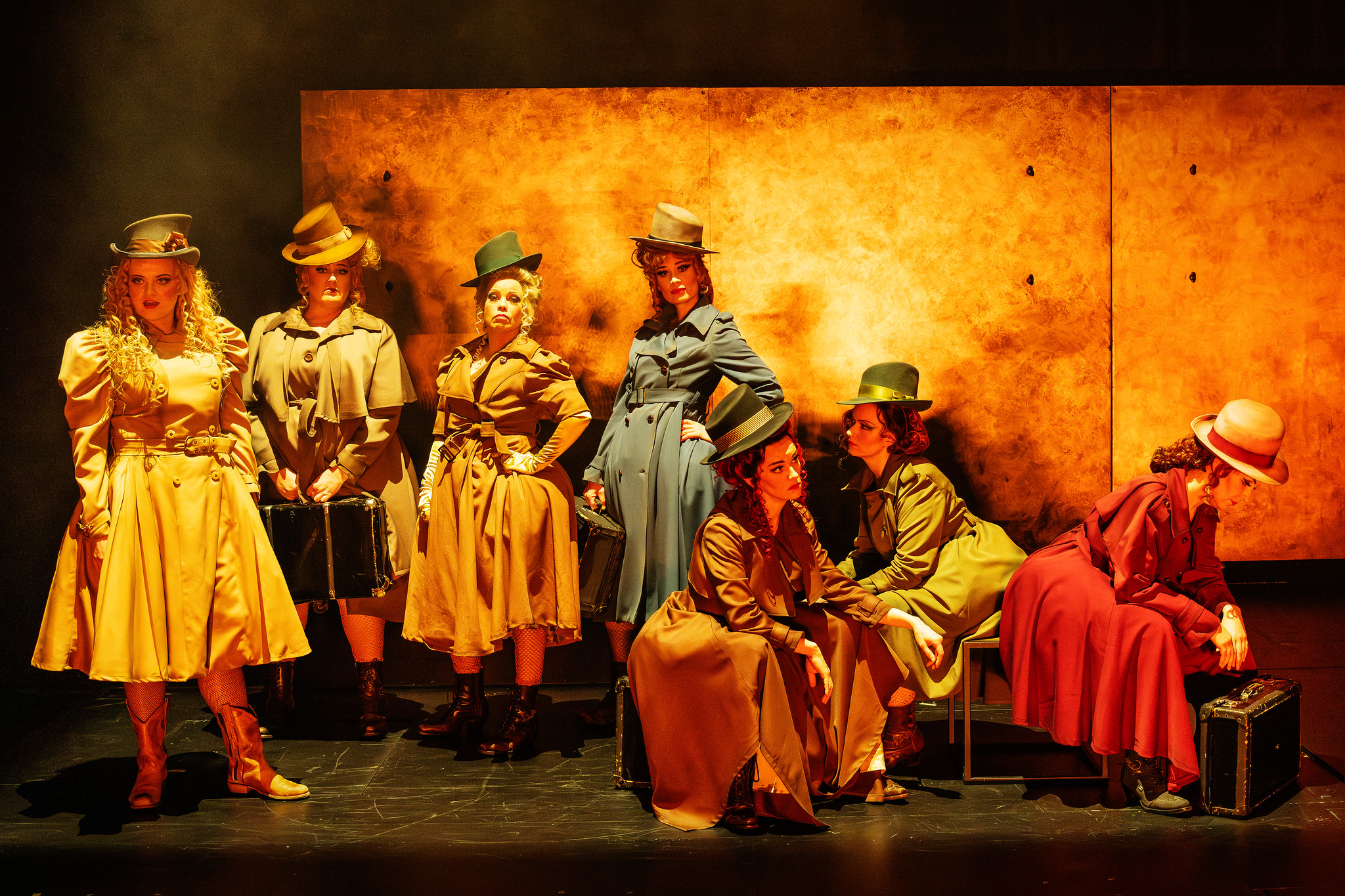
Referred to as both the Net City and the Golden City, Mahagonny lures its victims into a never-ending festival of consumerist hedonism and captures them like a net for edible birds (translated by W. H. Auden and Chester Kallman). The main characters are former lumberjacks from Alaska, proletarians now seeking mind-dumbing entertainment to compensate for the hardships and purposelessness of wage labor. Predictably, this logic of liberation fails. Ostensibly the pinnacle of freedom, the city binds its inhabitants with golden shackles – reminiscent of those keeping captive the slaves in Thomas More’s original Utopia (1516). This logic is aptly captured by the shimmering gold in the stage set.
Whoever has money, can attempt emancipation; yet precisely property and enjoyment enslave. The backward-looking words by the hedonistic lumberjack Jimmy Mahoney at the opera’s end are merely a first-person rendering of a broader analysis. I came to this city believing there was no happiness which money could not procure. That belief has been my downfall. … The joy I bought was no joy; the freedom I was sold was no freedom. I ate and remained unsatisfied; I drank and became all the thirstier. I’m damned and so, probably, are most of you. Give me a glass of water.
Abstraction causes meaninglessness
Mahagonny is a commercialized fantasy with a philosophical morale. If everything is allowed and available as a market commodity, there are no signposts to help the individual navigate toward actual meaningfulness. In Brecht’s time, numerous social theorists from Karl Marx to Max Weber, Georg Simmel, Émile Durkheim, and Ferdinand Tönnies had already proposed abstraction, alienation, and instrumentalization as key characteristics of modernity. The project of civilization, progress, and rationalization had produced its exact dialectical counterparts, and the artificial needs and utility functions created by capitalist economy caused cultural superficialization, as Max Horkheimer, Theodor W. Adorno, and Herbert Marcuse would propose particularly after 1945, building on Weimar-era analyses.
The project of civilization, progress, and rationalization had produced its exact dialectical counterparts.
Brecht’s wordplay with civilization and syphilis, supported by Weil’s accurate staccatos, encapsulates that tragedy concisely: off to Mahagonny … / where civ-civ-il-i-sation / will lose its scab and heal (auf nach Mahagonny … Die zi-zi-zi-zivilis, / die wird uns dort geheilt). Given the centrality of prostitution, or the commodification of love, for the storyline, venereal diseases are not merely a metaphor but indeed a synecdoche for Mahagonny, a condensed symbolic part capable of representing the whole. Additionally, the syphilis argument was widely utilized by Hitler and his followers at the time to justify diametrically opposite politics, and it thus encapsulates something of the multivocal ideological environment of the late Weimar Republic – a polity with numerous critics but few whole-hearted supporters.
The Leftist and Rightist diagnoses overlapped also in terms of the excessive economization of the society. Literally built on sand, Mahagonny reflects the rootlessness of money. All capitalist subjects, framed narrowly as consumers in the industrial society, enjoy intoxicants, gambling, and the marvels of commodified sex equally – provided they have enough of the substance that links these activities, money. Everything is exchangeable and everyone replaceable. The universality and apparent equality of the commercial society is a derivative of the universality, abstractness, and purely functional utility of money – an aspect theorized in Brecht’s time particularly by the early-20th-century sociologist Georg Simmel. Those who possess currency are equal no matter where they are, although some inhabitants of Mahagonny might be more equal than others, the play proposed.
Simultaneously, this countable liberty is paid for by the sense of detachment, on the one hand, and a nearly complete loss of inhibitions, on the other. Mahagonny is a story of abstraction, detachment, and dissolving communal solidarity. Not even his paid-for mistress agrees to save Jim Mahoney from bankruptcy and death. In Hannah Arendt’s (Reflections on Literature and Culture, 241) apt formulation, Mahagonny displays “no eternal love, or even ordinary faithfulness. There is nothing but the intensity of the moment; that is, passion, which is even a bit more perishable than man himself.”
All this follows, when humanity is reduced to consumerism, the opera argues. Here Mahagonny speaks to radical leftist and right-wing conservative audiences alike, and in the German tradition of social thought, the critical diagnoses of modernism and consumerism, coming from the left and the right, often eerily resemble one another.
Mahagonny is a story of abstraction, detachment, and dissolving communal solidarity.
Systemic satire
Not a vice is left unportrayed in Mahagonny. It would be erroneous, however, to conclude that the play shows human beings as they are. If Mahagonny evokes a sense of continued topicality, this is not because the play captures something of an unchanging human nature. On the contrary, Brecht, following Marx, regarded human beings as products of their economic and societal surroundings, and any continuities are to be explained with reference to prevailing systemic aspects. It is the economic and political environment that invites the vices manifested on stage – greed, exploitation, corruption, gluttony, hedonism, and many more –, not humans’ inherent sinfulness.
The only universality that the play signals is the abstract universality of money and money-based relationships, but this is a consequence rather than a cause. The core message of the play thus refuses any anthropological universalism, for that would be to abandon even the faintest hope of salvation. For Brecht, the society can indeed be changed, and it is the task of theatre to both communicate and exemplify that potential.
Brecht, following Marx, regarded human beings as products of their economic and societal surroundings.
Eventually, the contradictions inherent in the purely materialistic worldview of Mahagonnians seal the city’s fate. If monetary value is the only known value, there are in fact no values. And with the loss of other measurements, there are no restraints to keep poverty itself, absurdly, from becoming a deadly sin and an offence.
The play culminates in this expressive finding, sardonically commenting on the business logic of capitalist systems. For the penniless man / is the worst kind of criminal. / Beyond both pity and pardon. This, the play proposes, is the logical system-level outcome of the beatification of exchange value. Money alone matters, and eventually nothing else is recognized as sinful than the inability to sin further. For Adorno (“Mahagonny,” 71), this is the core of the play’s explosive societal relevance. “Its absurdity is actual and not symbolic. The present system, with its order, rights, and mores, is exposed as anarchy; we ourselves live in Mahagonny, where everything is permitted save one thing: having no money.”
Traditional and radical performance practices
Set somewhere between opera, theatre, and cabaret, Mahagonny is usually performed in opera houses. As the novel Turku Music Centre Fuuga only opens in the fall, this particularly performance, however, took place in a traditional theatre setting, which slightly shifts the frames of its radicality. Although radical, Brechtian epic theatre does not require a complete aesthetic rupture. After Mahagonny, Brecht theorized epic opera as utilizing the forms of traditional bourgeois opera but working subtly against both the form and the society it reflected. Still “sitting pretty on the old brach,” the work was already “sawing away at it,” he argued, adding that “real innovations attack the base” (Brecht on Theatre, 70).
Anti-opera in its intention, Mahagonny still lives off the tradition.
Anti-opera in its intention, Mahagonny still lives off the tradition. It is an unstable compound of high and low, combining the best traditions of German high culture with cabaret mannerism and absurd Americanism known from Brecht and Weill’s previous works. The music, too, borrows from the register of orchestrated entertainment. There are forceful ensemble scenes particularly toward the end, but also individual performances that merit praise, albeit primarily in the genre of cabaret rather than classical aria.
The music derives partly from the small-scale Mahagonny-Songspiel, a stage performance with characteristically American “songs”, which premiered already in 1927 and was gradually re-expanded into a full opera, although Weill probably worked on both alternately. Weill’s score carries allusions to opera classics of the past centuries, the choral parts occasionally resemble Bach’s, and we know also Brecht was familiar with the oratory tradition. Yet eventually Mahagonny lives off dissonances, jazz rhythms, and cabaret phrasing, intentionally creating intermediary musical genres set somewhere between tradition, avant-garde, and entertainment. Weill’s most captivating melodies reverberate long afterwards and carry the enclosed political message – particularly the one-liners no, said the men of Mahagonny and can’t help him or you or me or no one.
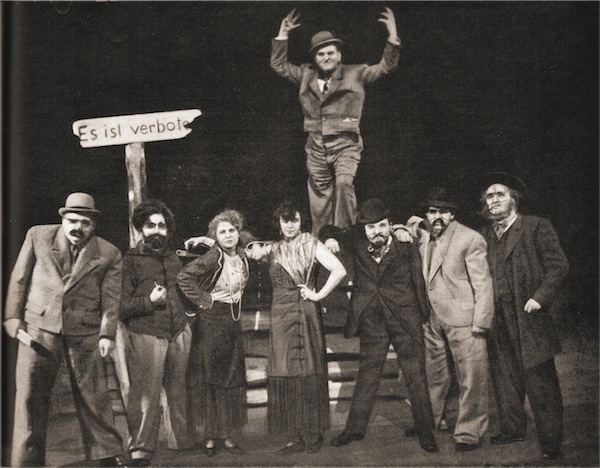
While still seeking to entertain with catchy tunes, Mahagonny criticized the society that needed such entertainment, being self-declaredly “culinary” in appealing to the senses, Brecht noted, yet anti-culinary in intention (Brecht on Theatre, 70). Its sarcastic commentary thus also hits standard social customs in opera and theatre life and subtly criticizes the audience for their hedonistic passivity. I’m damned and so, probably, are most of you.
The daytime show in Turku featured few evening gowns, though, and although the personnel doubtless mastered das Cocktail-Abc, intoxicants were consumed within limits. The ironical distance between the event’s habitually commercial-hedonistic surface and the play’s subversive message was somewhat downplayed by the modest venue and remained bearable.
Occasionally the performance tended toward rock musical expression, supported by corresponding lighting. In the 1960s, the originally sarcastic Alabama song (oh, show us the way to the next whisky bar) ended into the repertoire of The Doors, known for their cliché-like rock’n’roll lifestyle reminiscent of Mahagonnian recklessness, and became literal again. In the Turku production, Jim (sic) Mahoney held the microphone stand like Jim Morrison and injected intriguing temporal-ironical elements to the celebration of bourbon and promiscuity – reprehensible values certainly, yet exactly what our popular culture idolizes.
This insightful update reflects the role of artworks as transtemporal media, perpetually open for reception and full of expressive potential that escapes original intentions; think of Springsteen’s patently ironic Born in the USA being, mind-bogglingly, used for patriotic political campaigning.
Recently, Babylon Berlin (Netflix) has aestheticized the Weimar-era cabaret scene with similarly anachronistic references to later techno and rave culture. It is difficult to perceive the “roaring twenties” now without these additional layers, including the narratively decisive shadow of the subsequent National Socialist uprising. Yet Mahagonny, in deriving from its authors’ involvement in the Weimar-era theatre world, is the real thing. Alongside sawing through the branch of opera with its anti-opera measures, the play uses cabaret aesthetics to bring home its anti-entertainment point and critique of commercialized wantonness typically associated with interwar Berlin.
Destruction from without/within
An approaching typhoon momentarily sustains the sequence of stage images – a typhoon ironically alluded to in the opening scene (the raging typhoon will never bother us here). Nevertheless, after the danger passes, equally inexplicably, the capitalist excesses return with added vigor. Profoundly fed up with moralistic prohibitions, the lumberjack Jim Mahoney smashes the tablets of the law. The city rule now prescribes: you may do anything as long as you can pay for it.
Even if Mahagonny narrowly escapes destruction by a storm, the fate arises from within in the form of moral decay. We need no raging hurricane. / We need no bolt from the blue: / There’s no havoc which they might have done / That we cannot better do. What is the point of narrowly escaping a natural disaster only to be torn apart by one’s own nihilism, the opera appears to be asking.
Particularly this lesson resonates with our post-Covid-19 experiences of fossil-based mass tourism, declining biodiversity, and consequently inevitable future pandemics. When consumerism is marketed as a civic obligation to kickstart the stagnated economy, but the primary fiscal stimulation still comes from defense expenditure, the imagery Mahagonny puts forth receives completely novel ironical layers. The society will not improve through crisis, no matter whether the shocks are external or system-induced, we are reminded.
The original German audience had no first-hand experiences of typhoons or the increased literal likelihood thereof; the symbolic dimension was therefore more pronounced. The typhoon was a habitual metaphor for social cataclysm ever since 1789 and, for Brecht’s contemporaries, it presumably resonated with the recent memory of a failed socialist revolution in 1918–19. The exoticism of a tropical typhoon further underscored the public’s wide-spread unfamiliarity with revolutionary politics: a menace from a different world, the potential proletarian uprising caused panic yet inexplicably failed to materialize.
Brecht’s typhoon – only indirectly implied on stage, and almost transcendental – may be intended to further emphasize the play’s consistent lack of guidance and effective political solutions and thereby reflect Brecht’s distance from organized mass politics. Mahagonny portrays the problem and the capitalist tendency to self-destruct without offering a roadmap for redemption.
We live in conditions of irreversible global warming, which, ironically, makes typhoons more likely than in Mahagonny’s context of emergence.
Nowadays, by contrast, we live in conditions of irreversible global warming, which, ironically, makes typhoons more likely than in Mahagonny’s context of emergence, and the globalized media landscape allows no blind eye even for those residing by the calm Baltic Sea. The exoticism has been naturalized, and the typhoon’s symbolic point of reference has altered. We accept as a given that there are no viable alternatives to market economy and the concomitant commercialism, and old-school self-destruction prophecies have lost their credibility. It is difficult not to project these starting points onto the performance.
However, in the meanwhile, the typhoon has been incorporated into capitalism’s cost structure. In dramaturgical terms, it remains as absurd a deus ex machina as before; yet nowadays typhoons are causally linked with the capitalist logic at the opera’s focus, and Mahagonny’s propositions appear as increasingly apt. We are no longer at nature’s mercy but rather control it, as scientists from the 17th century onward fantasized, at least insofar as our economic-social structure can in fact generate natural disasters. The humanity is capable of self-destruction much more acutely and in more ways than in Brecht’s time, yet the self-imposed nature of the destruction remains. What Brecht describes in terms of moral decline has nowadays assumed characteristics of a physical menace, and the money/typhoon relationship is not merely symbolic, but causal and intrinsic. We have effectively internalized the typhoon.
Brechtian principles in Turku
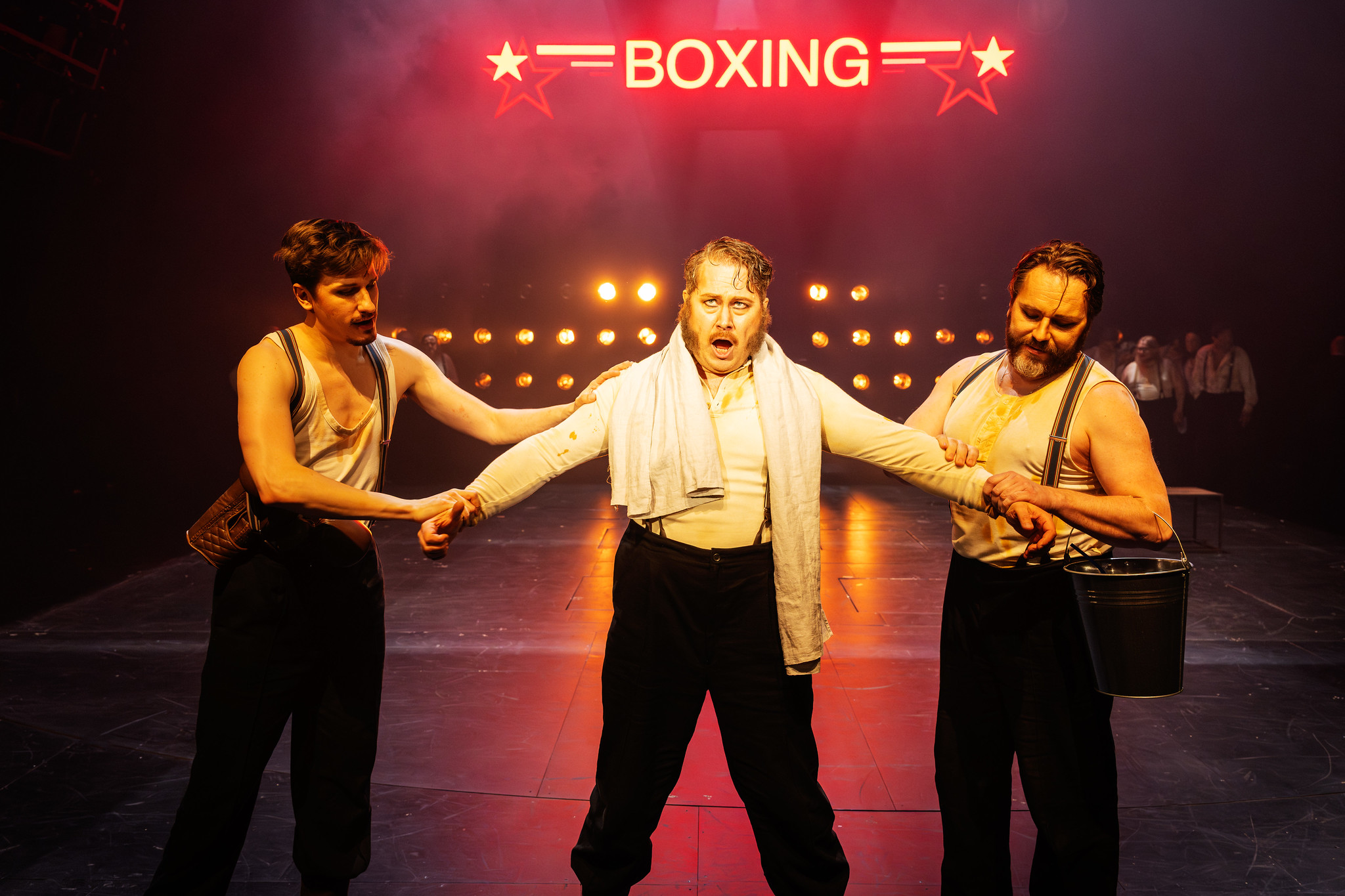
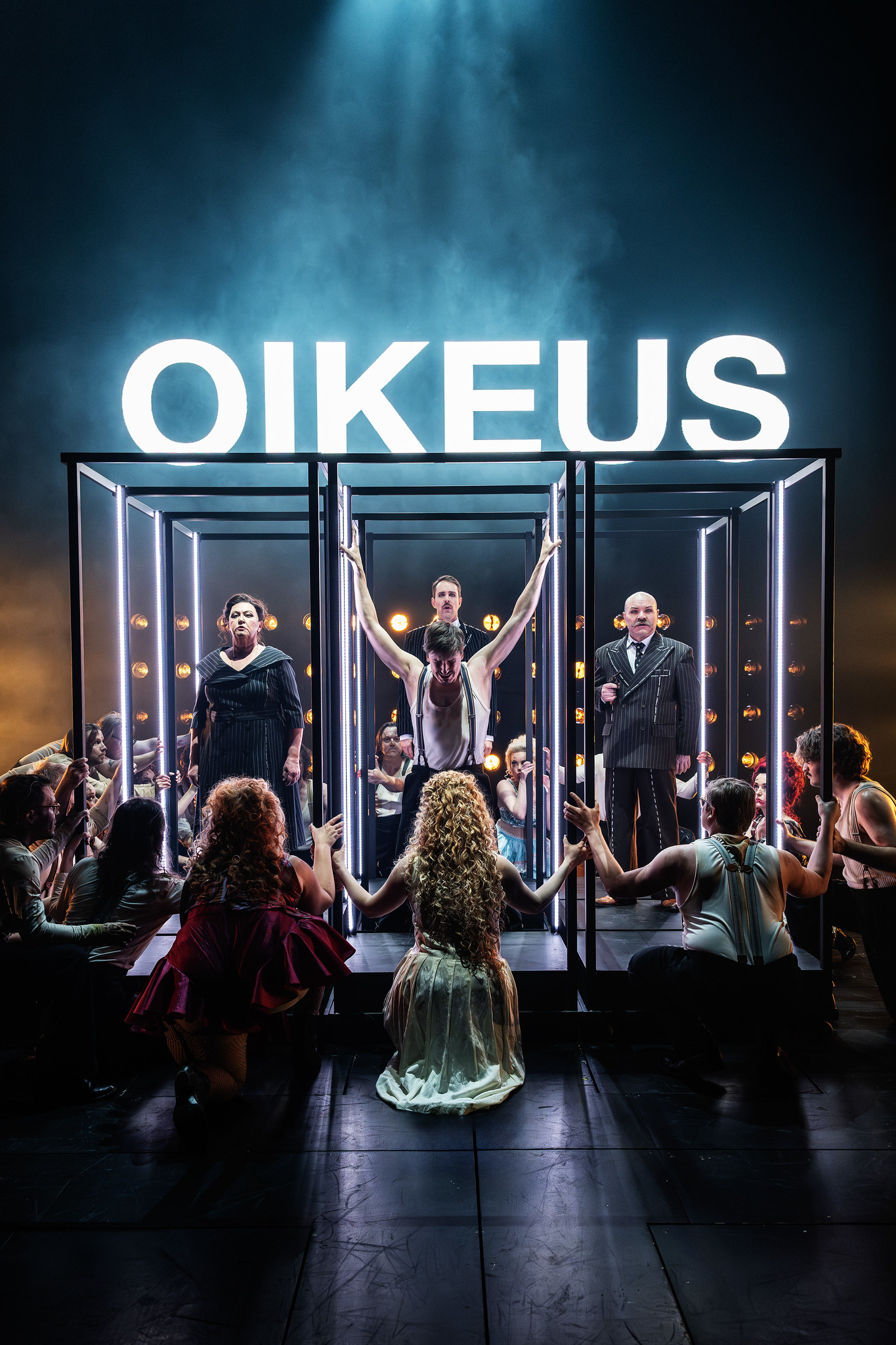
How well are the critical-didactic aspects of the play, however, eventually transmitted in the Turku rendering? To what extent does it manifest the principles of Brechtian epic theatre? The stage was straightforwardly set in gold and dingy matte black with lots of multi-purpose functionality and occasional nightclub glamour. Stage lighting was the primary means of creating atmosphere, occasionally combined with smoke and reflecting mirrors. By and large, the lighting followed Brechtian principles: the spotlights were deliberately shown to the audience, and on stage they were carried by staff members dressed in modern work clothing. These elements disrupted the action’s spontaneity and the audience’s capacity for identification, creating a sense of distance.
It was an obsolete bourgeois practice to conceal musicians to sustain illusion and identification.
The orchestra, by contrast, deviates from the dogmas of epic theatre. Partly owing to their cabaret past, Brecht and Weill employed dance band musicians and left the orchestra in full view, which further reminded the audience that they were following a performance. It was an obsolete bourgeois practice to conceal musicians to sustain illusion and identification, or “to cover the orchestra pit,” as Benjamin (Understanding Brecht, 1) noted, highlighting Brecht’s radicality in this regard.
In Turku, however, the orchestra remained behind the stage, effectively hidden by an opaque backdrop. With current advanced audio technology, one could not, without consulting the program leaflet, even know that a live orchestra was playing. While spatial limitations determined this choice rather than artistic principles, the opera consequently drifted toward classical illusion-based drama.
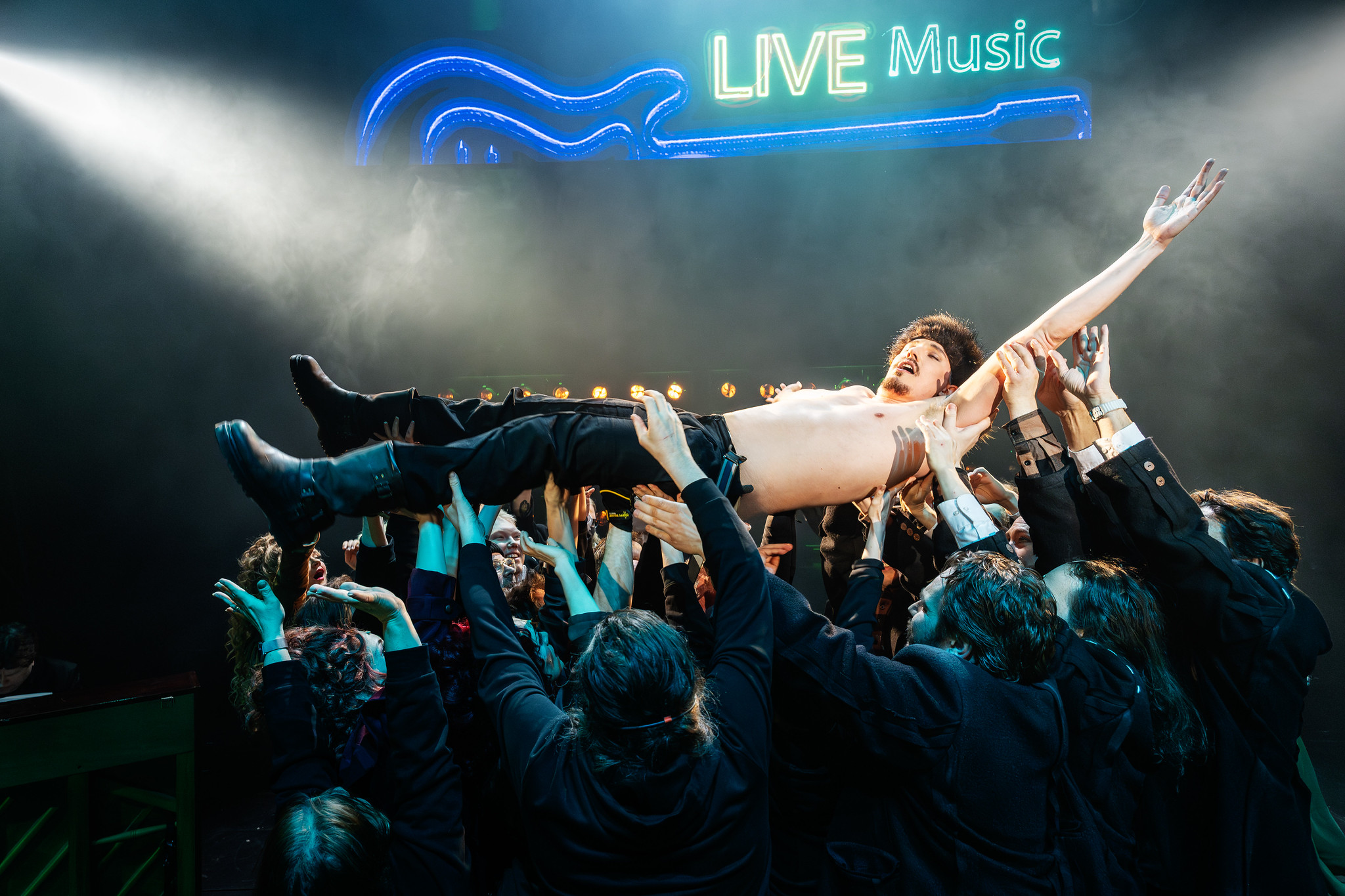
The original stage projections had been reduced to a bare minimum, which affects the overall interpretation. Crime statistics and price lists typically frame the early events in other productions, but less so in Turku, whereas general rock club aesthetics had been added. Prohibition signs were used to express the city’s evolving moral code, albeit sparingly.
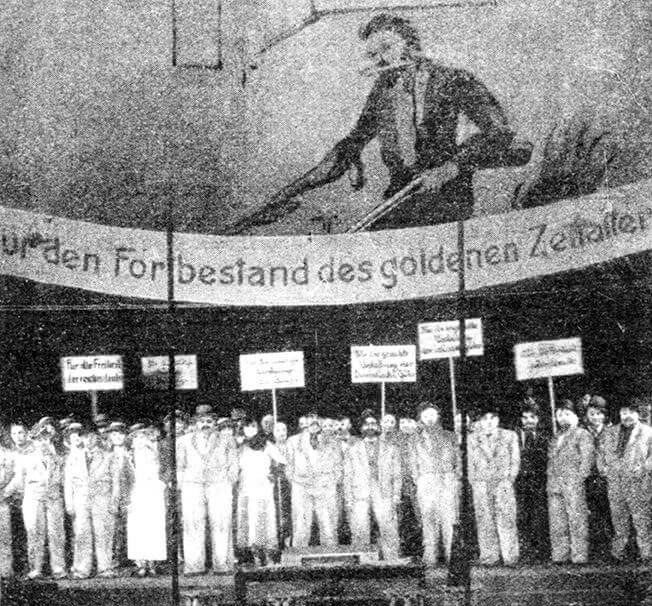
Particularly significant is the removal of demonstration signs from the opera’s apocalyptic finale. In Brecht’s original script, riots emerge to protest rising prices, and Mahagonny is set ablaze. Apparently learning nothing from their past, the remaining citizens march for their old ideals under banners with bizarre slogans like “for money,” “for the struggle of all against all,” “for property,” “for theft,” “for the commodification of love,” or “for unrestricted murder.”
The absurd end scene simultaneously mocks the ideological diversity of the late Weimar Republic, demonstrations as a shallow form of political participation, and the unsustainability of bourgeois ideals as perceived from the proletariat’s perspective, thus adding further ambivalence. “For the continuation of the golden age,” reads one of the signs, repeatedly shown with increasing font size in Brecht’s instructions.
Particularly significant is the removal of demonstration signs from the opera’s apocalyptic finale
In Turku, by contrast, the projections followed and further invigorated the sung message can’t do anything to help a dead man and can’t help him or you or me or no one, whereby the interaction between the demonstrators and the dramatic choir, apparently addressing the audience directly, disappeared. The condensation of this carnivalesque scene into promotion of the play’s overall message alters the post-play impression of Mahagonny’s immediate political relevance. It emerges as less multivocal and ironic than originally intended.
Mahagonny as a political work of art
Although the play promotes a perspective, it would be overly simplistic to reduce it into closed agitative propaganda alone. The core idea of Brechtian epic theatre is to activate the audience member’s own reflection on the societal phenomena depicted and to thereby serve as a counterforce to the bourgeois cultural forms that according to Marx’s theory of alienation lull citizens to sleepy indifference. To dictate a single dogmatic solution from above would contradict these very principles. Precisely this contributes to Mahagonny’s sustained relevance even amid partly altered challenges.
Brecht’s work amounts to political theatre in a more elaborate sense than sheer agitprop. Brecht himself learned the basic of political theatre from Erwin Piscator (1893–1966) whose productions more directly proclaimed an ideology and educated the audience on contemporary topics like war, revolution, political justice, race, or oil, seeking to turn the theatre into a “parliament” capable of political judgments, Brecht later observed (Brecht on Theatre, 136). While adopting the practices and principles of Piscator’s epic theatre, alongside the very term, Brecht shifted the emphasis to active critical reasoning by audience members – critical thinking and impulses coming from within were central, and conclusions would follow.
Like most other works by Brecht, Mahagonny is inescapably political insofar as it satirically exaggerates a harmful societal logic, promotes political awareness, and calls for action; it is radical both in its aesthetics and intellectual content, showing the need for fundamental rupture-like transformation of the basis of art and society alike. Brecht followed the young Marx who maintained that philosophers have only interpreted the world whereas the task is to change it and sought to implement this well-known principle in the theatre.
Engaging seriously with Marxian dialectics since the mid-1920s, Brecht was a committed ideological Marxist; yet he was never a member of any Communist party and had unorthodox, even heretic ideological traits insofar as his engagement with Marxism was led by the renegade Marxist philosopher Karl Korsch, who condemned Leninism and Stalinism as deviations from Marx’s original theories and became a persona non grata in institutionalized communism. Brecht’s approach was similarly autonomous rather than institutionally dogmatic, and, with Korsch, he sought to reinterpret and transfer the original Marxian principle of dialectics onto the stage.
Even if we accepted the conclusion that Brecht contradicted himself and wrote more propagandistically than his theoretical starting points would allow and that Mahagonny is therefore a mere dull propagandistic exercise, there are other dimensions of politicality at play. The discussion around Brecht’s political commitments has, unexpectedly, been rich in polemics, not the least because of the Brecht’s apparent support for Stalinist politics, including purges of dissidents, particularly in the didactic play Measures Taken (1930).
After having been forced to testify before the House Committee on Un-American Activities in 1947 and escaping to East Germany, Brecht was at the focus of a controversy. Even such a receptive reader as the political theorist Hannah Arendt polemically claimed that Brecht wrote “odes to Stalin” (Men in Dark Times, 213), whereas indirect acceptance of the Stalinist machinery and theory-inspired admiration for ideological purity even at the cost of political violence would perhaps be closer to the truth – patently unacceptable positions in their own right. Brecht’s political talent lay in identifying problems rather than in solving them; his politicality was that of an artist.
Brecht’s political talent lay in identifying problems rather than in solving them; his politicality was that of an artist.
For Brecht, theatre had always been political, but before the rise of the working class and Piscator’s artistic work, the politics of the theatre simply harmonized with how the bourgeois viewed the world, and the political stakes in drama went largely unidentified. The politicality in question is thus that related to how social reality is organized, represented, and justified, and it may manifest as either supporting or questioning the status quo.
Due to their common anchoring in the Marxist tradition, this notion of politicality primarily harmonizes with the work of contemporary critical theorists, such as the French philosopher Jacques Rancière or the Belgian philosopher Chantal Mouffe. Rancière links the political with the “partition of the sensible,” i.e. how the world is aesthetically organized to be perceived with the human senses, what qualifies as real, and in particular who are counted as legitimate subjects that have a say in processes of collective meaning-making.
With its critical interventions, art can reconfigure such divisions and thereby carries significant political potential, being not merely a reflection of political divisions but a factor in them. In this reading, art assumes political significance simply by depicting reality and has politics of its own, irreducible to the artist’s formal ideological commitments.
For Mouffe, politics is about disagreement and conflict – the erection, upholding, and recreation of hegemonic power complexes or opposing them with antihegemonic interventions. Like Brecht, Mouffe perceives all art as inherently political insofar as it either upholds or questions hegemony. For both Rancière and Mouffe, politics is not only about direct material interests as mediated by the formal party system, but about how the world appears, what counts as reasonable or as being in harmony with the common sense. Theatre’s political potential, too, relies on its ability to show and critically reconfigure.
In line with the young Marx’s call for changing the world rather than only interpreting it, Brechtian theatre seeks to radically alter our perceptions of social reality and thereby contribute to long-term systemic change. “Brecht always thought politically” and “never had an idea or an experience which was not at once filtered through the political,” the contemporary Marxist critic Fredric Jameson (Brecht and Method, 7) once formulated.
Yet, Brecht was no politician or political theorist. His artistic work shows the need for revolutionary political action without indicating how to conduct the transformation. As Rancière has noted, recycling formulations by Claude Lefort, politics, “designated by Brecht as the place of decision-making, remains an empty place,” indeed “an empty stage.” (Rancière, The Politics of Literature, 106). In its montage-like sequence of overindulgence, Mahagonny temporarily fills the stage with political actors; when the curtain falls, we, however, are the ones who need to solve and decide.
Timo Pankakoski, Doc.Soc.Sc. and Title of Docent (Associate Professor) in Political Science, is currently a Grant Researcher in political science, University of Helsinki. His work focuses on political theory, (German) intellectual history, conceptual history, metaphor studies, and related matters (Orcid id: 0000-0002-4076-9717). This review essay is a part of his current project Reconsidering the Political: Concept, History, and Applications, funded by the Kone Foundation (2026–28).
Literature
Theodor W. Adorno, “Mahagonny,” Discourse, 12:1, 1989–90, 70–77.
Hannah Arendt, Men in Dark Times (New York: Hartcourt, Brace & World, 1968).
Hannah Arendt, Reflections on Literature and Culture, ed. Susannah Young-ah Gottlieb (Stanford: Stanford University Press, 2007).
Walter Benjamin, Understanding Brecht, trans. Anna Bostock (London: Verso, 1998).
Martin Bevermann, Brecht and Tragedy: Radicalism, Traditionalism, Eristics (Cambridge: Cambridge University Press, 2022).
Bertolt Brecht, Aufstieg und Fall der Stadt Mahagonny (Frankfurt am Main: Suhrkamp, 1970).
Bertolt Brecht, Brecht on Theatre, ed. Marc Silberman, Steve Giles & Tom Kuhn, Third Edition (London: Bloomsbury, 2015).
Bertolt Brecht, The Rise and Fall of the City of Mahagonny, trans. W. H. Auden & Chester Kallman (Boston: Godine, 1976).
The Cambridge Companion to Brecht, Second Edition, ed. Peter Thomson & Glendyr Sacks (Cambridge: Cambridge University Press, 2006).
Stephen Hinton, Weill’s Musical Theatre: Stages of Reform (Berkeley: University of California Press, 2012).
Robert Hunter, “The Music of Change: Utopia Transformation in Aufstieg und Fall der Stadt Mahagonny and Der Silbersee,” Utopian Studies 21:2, 2010, 293–312.
Fredric Jameson, Brecht and Method (London: Verso, 1998).
Patchen Markell, “Politics and the Case of Poetry: Arendt on Brecht,” Modern Intellectual History 15:2, 2018, 503–533.
Chantal Mouffe, Rosalyn Deutsche, Branden W. Joseph, & Thomas Keenan, “Every Form of Art has a Political Dimension,” Grey Room 2, 2001, 98–125.
Jacques Rancière, The Politics of Literature, trans. Julie Rose (Cambridge: Polity, 2011).
John Willett, Brecht in Context: Comparative Approaches, New Revised Edition (London: Bloomsbury, 1998[1984]).